Don’t Let the Critics Curate Your Show

Shared Preparation for LGBTQ+ History in a Municipal Museum
By Adrian J. Cardwell and Jennifer S. Landry
In 2025, a city-owned museum in Irving, Texas, a Dallas–Fort Worth suburb, prepared to open Badge Of Pride: From Silence…To Celebration!, an LGBTQ+ history exhibition, amid widening efforts to censor LGBTQ+ stories and limit their visibility. Badge Of Pride and the Irving Archives & Museum (IAM) prepared on two fronts. One was familiar: developing the narrative, preparing more than 600 artifacts, refining labels, translating text, and testing participatory elements. The other unfolded in board meetings, city offices, staff conversations, and planning calls: presentations to the museum’s governing board, discussions with city leadership, crisis-communication planning, and procedures to distinguish protected protest from threats to visitor safety or museum operations.
The exhibition grew out of a three-year partnership between IAM, a midsize municipal museum, and Badge Of Pride, a grassroots LGBTQ+ history nonprofit. Badge Of Pride led the curatorial work, drawing on its collection and relationships within the LGBTQ+ community. Community advisers shaped the narrative. As the host institution, IAM was responsible for professional standards and visitor services, and for explaining and defending the exhibition’s content and interpretive choices if they drew public or political criticism. This division preserved community authority while making institutional accountability explicit.
Museum and city staff had reason to anticipate public and political opposition. In 2024, a routine city social media post recognizing Pride drew hundreds of hateful comments before the city removed it from public view.1 The backlash reflected a broader climate: that year, pressure groups and government entities initiated 72% of demands to censor books in school and public libraries, and the inclusion of LGBTQ+ characters or themes was among the most common justifications (American Library Association, 2025).
Opposition was one audience to prepare for, but it could not become the exhibition’s primary audience. Anticipating objections carried its own risk: it could begin to shape the exhibition before it opened. The exhibition needed historical grounding, clear access, and staff prepared to support it. If anticipated objections determined its scope, language, or tone, the critics would already be curating the show.
Turn the Plan into Proof
Badge Of Pride founder and executive director Adrian J. Cardwell drafted a formal interpretive plan that defined the story the exhibition would tell, the evidence supporting it, and what visitors would be invited to understand, question, or recognize. The plan organized the exhibition around four themes: Claiming Identity; Resisting Oppression; AIDS: Surviving a Plague; and Celebrating Pride & Power. These themes created a clear narrative arc across the galleries, conveyed through artifacts, audiovisual storytelling, community voices, and accessible writing. By linking each decision to research, artifacts, and a defined interpretive framework, the plan made the reasoning visible and the process accountable. It also provided institutional leaders with a guide for assessing and defending the work if it became a political target.
That clarity mattered in a city-owned museum, where questions about exhibition content could quickly reach board meetings and city offices. When Jennifer S. Landry, director of museums at Irving Archives & Museum, and her staff encountered questions rooted in rumor or assumption, they could return to the plan: What history are we telling? What evidence supports it? What should visitors be able to encounter and consider? The plan enabled leaders to assess the research and reasoning without taking over the exhibition’s content.
In June 2024, Badge Of Pride translated the interpretive plan into a public pop-up exhibition at IAM. Until then, key Irving decision-makers had largely encountered the project as an abstraction and, increasingly, as a political risk. Years of research and community collaboration could have been reduced to the dismissive label “an LGBTQ+ exhibition” rather than recognized as part of the community’s shared history.
The prototype shifted the conversation. Staff, board members, and city leaders evaluated a sample of planned content and materials: publications, protest materials, political buttons, photographs, textiles, correspondence, and everyday objects. They saw that the exhibition would directly and carefully address criminalization, discrimination, the AIDS crisis, violence, and loss, without allowing those histories to define LGBTQ+ life as a whole. The prototype also showed how it would trace community building, culture, love and joy, Pride, organizing, and political victories.

The prototype served as a trust-building proof of concept and a common reference point without ceding the community’s authority over its own history. A Dallas Voice article about the pop-up showed the partners how the work might be framed publicly (Taffet, 2024). Beyond testing visitor comprehension or interaction, it helped staff and city leaders understand the exhibition ahead of the full-scale build.
Make the Case Without Changing the Rules
At IAM, most exhibitions do not require a board presentation. This one required three formal presentations and discussions with communications staff, attorneys, city management, and elected officials. Some questions concerned the proposed exhibition; others reflected a climate in which LGBTQ+ themes are presumed inherently sexual, partisan, or inappropriate for public consumption. Concerns usually reached the partners indirectly. Landry repeatedly invited those raising them to meet during development, but none accepted. The museum later invited leadership and those who had questioned the project to the opening preview. One individual who had challenged the project spent considerable time reviewing it, called it well done, and offered constructive feedback. The conversation shifted from challenging the project’s premise to engaging with its content.
Warnings circulated about protests, membership losses, political consequences, and threats to staff positions. Each had to be assessed without letting speculation drive the content. Repeated presentations clarified what the exhibition contained, how decisions were made, and who was responsible. They also exposed an inequity: the LGBTQ+ community was repeatedly asked to prove that its history belonged in the museum, an extra burden not imposed on other exhibitions.
Institutions should not impose extraordinary approval requirements on exhibitions expected to attract controversy, especially those presenting marginalized histories. Community partners and advisers should not serve as the exhibition’s defense committee. Institutions must apply the same curatorial standards they use elsewhere and take responsibility for public challenges.
Briefing leadership differs from asking leadership to approve the work. In this case, repeated briefings kept museum, city, legal, and communications leaders informed about the exhibition’s content, the decision-making process, and the support staff might need. Because those leaders had already encountered the exhibition and its rationale, a late complaint would not leave them without context.
The responsibilities were clearly defined. Badge Of Pride and community advisers shaped the historical narrative; the museum managed the public response; city departments coordinated; frontline staff welcomed visitors and routed concerns; and law enforcement played a limited role when safety thresholds were met. The goal was not to predict every possible challenge but to ensure that, if one arose, people knew who was responsible, what information they needed, and when a situation required more than a routine response.
Build a Response Plan Staff Can Use
Planning began with a simple premise: public comment, protected protest, online escalation, operational disruption, and threats to visitor safety were distinct situations requiring different responses. The plan and staff FAQ outlined how to handle each, specifying who would assess a situation, who would speak for the institution, and how information would flow among museum staff and city leadership. That structure also reflects a basic principle of crisis communication: different situations call for different responses, informed by the people affected and the institution’s role in each situation (Dominic, 2025). The museum also met with law enforcement to explain the exhibition and establish points of contact. Designated officers received the public-program calendar and a monthly manager-on-duty roster, and staff received a clear call sequence.
Law enforcement involvement required careful consideration. LGBTQ+ communities have ample historical and contemporary reasons to distrust policing. Clear thresholds enabled staff to respect the right to peaceful protest and to escalate only when safety or museum operations were at risk.
The approach was tested during opening weekend, when a small group gathered across the street from IAM. Staff notified designated contacts, and officers observed from a distance. The protest concluded without incident. No protester entered the museum or interfered with visitors.
Prepare for Welcome
Preparation also meant removing barriers before visitors arrived. Badge Of Pride raised funds to keep admission free. The exhibition was professionally translated into gender-inclusive Spanish, reflecting a commitment to North Texas’s large Latine population, including its Spanish-speaking LGBTQ+ communities. A free Bloomberg Connects guide offered extended artifact descriptions, audio stories, and curator commentary, available both onsite and online.
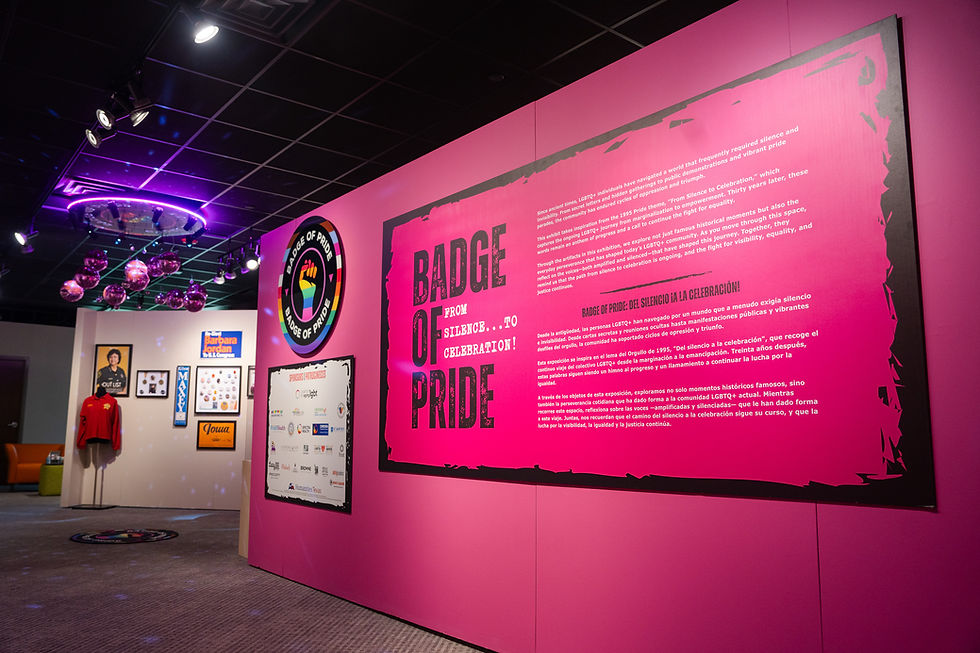
April Baker, the museum’s assistant director, later identified a gap in that preparation. From the front desk, she watched some visitors arrive, reluctant even to say they had come for Badge Of Pride, then return from the galleries visibly more at ease. In hindsight, Baker suggested language for that first encounter: “We’re so glad you’re here. We’re so proud of this exhibit.” The museum prepared staff to manage resistance, but in reflection, Baker felt it could have done more to make the welcome explicit at the door.2
During final preparations, Landry was asked to include a National AIDS Memorial Quilt block that memorialized someone with a direct personal connection to a city leader. The panel fit the existing AIDS narrative and strengthened its local connection, so Badge Of Pride secured it through its relationship with the National AIDS Memorial. It situated LGBTQ+ history within Irving’s community and created a tangible link to grief and memory. What some dismissed as outside ideology was, in fact, part of the city’s own story.

What We Prepared For, and What Visitors Reported
The four-month exhibition ended without the opposition many had anticipated. The museum did not receive a flood of complaints, face disruptions, or lose members. Instead, membership and museum store sales reached record highs. More than 3,000 people visited, marking the highest attendance for a temporary exhibition.
Preparation did not eliminate opposition. It gave staff a way to respond to a small protest without treating it as a crisis or allowing it to define the exhibition. That, too, is part of what success looks like.
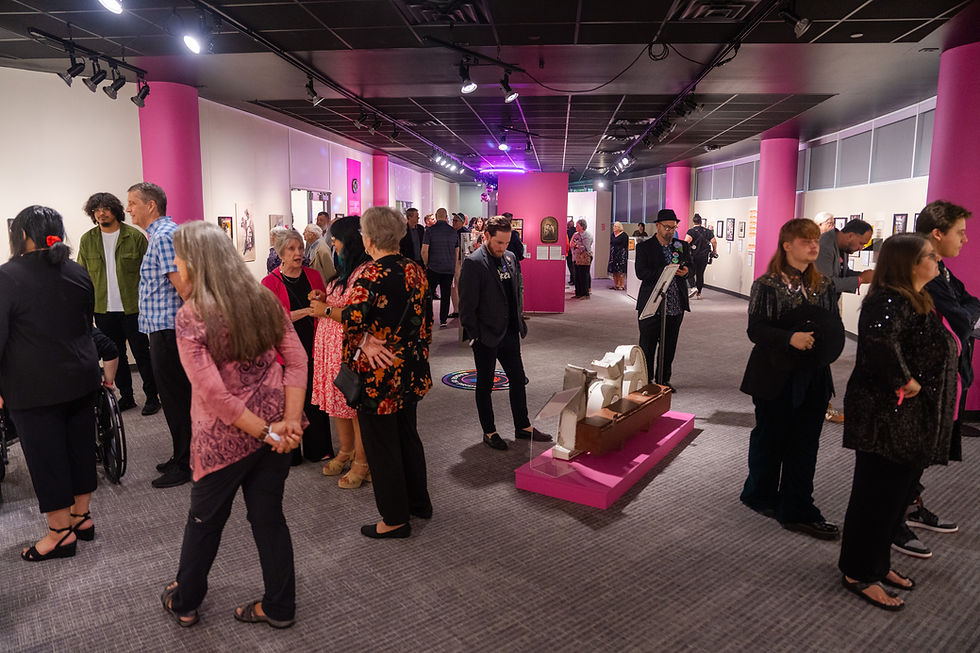
A post-exhibition impact report compiled 214 voluntary responses from surveys, docent conversations, and in-gallery cards, representing roughly 7% of total attendance. The self-selected sample cannot determine how all visitors responded, but it can indicate what some visitors took away from the experience (Cardwell, 2026).
One respondent wrote that the exhibition “anchored the knowledge I already had, opened my eyes to new elements, and urged me to keep exploring,” and added that two friends from different generations “learned from the exhibit AND each other.” A handwritten card read, “What gives me hope is our elders. Seeing love survive. It’s the only reason I know I’ll survive.” Another visitor thanked the museum for “timely and bold exhibits that do not shrink from subjects that politics are trying to marginalize.” Within the limits of a self-selected sample, these responses suggest that some visitors reported learning, intergenerational connection, and recognition (Cardwell, 2026).
Five Practices for Other Institutions
The following practices translate those lessons into an approach that other institutions can adapt to prepare for contested community histories.
Develop an interpretive plan. A clear plan makes the research and reasoning behind curatorial decisions visible and keeps questions focused on evidence, visitor goals, and accountability.
Prototype the work early. Provide staff, governing bodies, and civic leaders with tangible objects and content to consider rather than theoretical controversies.
Define authority and responsibility. Community partners should shape the historical narrative, while museum leaders must uphold the agreed-upon curatorial standards and respond to public challenges to the work.
Replace general assurances with proportional procedures. Provide staff with named contacts, decision points, and an escalation sequence that distinguishes protected speech from genuine threats.
Plan for resistance while preparing for welcome. Risk procedures should protect visitors and staff, and frontline training should provide clear language for signaling welcome from the first interaction. Access planning should also address price, language, format, and reach.
By opening day, the exhibition remained intact. Badge Of Pride retained authority over the narrative, grounded in research and artifacts and accountable to the communities whose history it presented, while IAM was prepared to stand behind the work, welcome visitors, and address challenges without shifting that burden to its community partner. Together, they had made room for public response without letting critics curate the show.
Works Cited
American Library Association. (2025, April 7). American Library Association kicks off National Library Week with the Top 10 Most Challenged Books of 2024 and the State of America’s Libraries Report. https://www.ala.org/news/2025/04/american-library-association-kicks-national-library-week-top-10-most-challenged-books
Cardwell, A. J. (2026). Visitor feedback impact & evaluation report. Badge Of Pride. Response identifiers R027, R152, and R016.
Dominic, E. D. (2025). Crisis communication revisited: Theoretical evolution, limitations, and integrative insights. International Journal of Research and Innovation in Social Science, 9(10), 9735–9752. https://doi.org/10.47772/IJRISS.2025.910000796
Taffet, D. (2024, June 6). LGBTQ exhibit opens in Irving. Dallas Voice. https://dallasvoice.com/lgbtq-exhibit-opens-in-irving
Endnotes
Authors’ notes from conversations with City of Irving leadership, June 2024. Pride and Juneteenth social media posts drew hundreds of hateful comments over several days and were removed from public view. The city later stopped posting general holiday content on its social media channels.
Notes from A. Baker, interview by Adrian J. Cardwell, August 16, 2026.


Comments